

South
City SC Utah – South
Mission Statement. City SC Utah South – is a premier youth development academy committed to developing both exceptional soccer players and outstanding young people. Through modern, research-based training methods, professional-level coaching, and a competitive development pathway for committed, serious players, we foster technical excellence, tactical intelligence, and a strong work ethic both physically and mentally. Our program emphasizes leadership, confidence, faith-centered values, and a service-minded character, creating an environment where every player feels valued, supported, and challenged to reach their full potential on and off the field.
To be Utah’s premier youth soccer academy and club, developing players through elite, research-backed training, advanced coaching, and leadership development, preparing them to dominate at the highest levels of soccer and life.
Location: City SC Utah – South is based in the metropolitan area at the heart of Utah County, serving players and families in Lehi, Saratoga Springs, American Fork, Pleasant Grove and Eagle Mountain.
Administration
| Position | Staff | |
|---|---|---|
| Executive Director | Jeremy Alvernaz | jalvernaz@cityscutah.com |
| DOC | Coquito De Vettori | cdevettori@cityscutah.com |
| Registrar | Gina De Vettori | gdevettori@cityscutah.com |
| Club Treasurer | ||
| Media | Luzmary Alvernaz | lalvernaz@cityscutah.com |
| Deputy Director |
Leadership
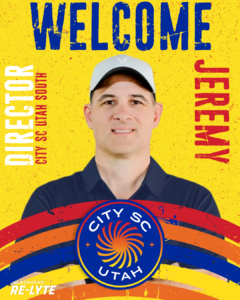
Jeremy Alvernaz
Executive Director
Jeremy Alvernaz is a Saratoga Springs resident with a deep passion for developing young athletes through the game of soccer. Originally from San Diego, California, Jeremy began playing soccer at a young age and continued competing throughout his high school years.
After graduating, Jeremy served a mission for The Church of Jesus Christ of Latter-day Saints in Venezuela. Following his mission, he joined the United States Army, where he served as a Special Forces Green Beret. He later continued his military career in leadership roles within the Utah National Guard and recently retired in May 2024 as an Army Captain.
Jeremy has over 15 years of experience coaching youth soccer at multiple levels. He has coached on both the boys’ and girls’ sides of the Westlake High School soccer programs and currently serves as the Head Coach of the Westlake High School Girls Varsity Soccer team.
Jeremy previously served as a founding leader and Director of Coaching for a Utah youth soccer club that grew to more than 800 players within five years, helping establish the club’s player development structure, coaching standards, and long-term competitive pathway.
He holds a Master’s Degree in Coaching and Athletic Administration, where his graduate research focused on non-linear pedagogy and skill acquisition in youth soccer development. Jeremy also places strong emphasis on physical preparation and previously held certification as a CrossFit Level 1 Trainer.
He holds several coaching certifications through United Soccer Coaches, including:
- Foundations of Coaching Diploma
- Creating Talent Diploma
- 11v11 Formations and Systems of Play Diploma
- Futsal Level 1 Certification
- Goalkeeper Level 1 Certification
Jeremy is currently enrolled in the U.S. Soccer Federation National “A” License Course, one of the highest levels of coaching education in the United States. He is fluent in Spanish and enjoys working with players and families from diverse backgrounds while helping athletes grow not only as soccer players, but as confident and disciplined young people.Jeremy believes the best player development environments challenge athletes technically, tactically, physically, and mentally while building character, discipline, and a lifelong love for the game.
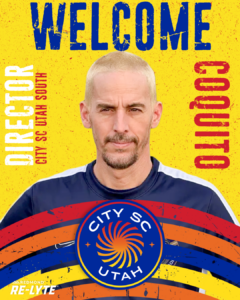
Coquito (DeVo) De Vettori
Technical Director / DOC
Fútbol has always been in Coquito’s (DeVo’s) blood, passed down through his family. His father, Coco (Italian-Peruvian) moved to Washington State from South America (street baller) and play professionally with SeaTac & Heidelberg (before the NASL / Sounders era), played against touring teams like Newcastle United (EPL). His name is enshrined in the Washington State Legends of Soccer Hall of Fame: Link.
DeVo started playing soccer at a very early age, quickly becoming involved in the top premier league and traveling throughout Washington State to compete at the highest level.
He attended Pierce College, where he played a pivotal role in leading the team to their first-ever NWAACC Soccer Championship, finishing the season undefeated. His outstanding performance earned him a spot on the First Team Southern Division All-Star selection and in recognition of his contributions, he was inducted into the Northwest Athletic Conference (NWAC) Hall of Fame. Read more here.
DeVo’s journey in soccer continued when he moved South to play at the University of Mobile, where he helped lead the team to Nationals.
After his time at the University of Mobile, he took the next step in his career playing professionally with the Mobile Revelers in the USISL D3 Pro League, at a time when Major League Soccer (MLS) was just beginning to take shape.
It was in the South that DeVo met his wife, which led him to relocate to the West Coast.
His coaching career started with Wembley Soccer, where he ran camps for James Charette, the Director of Coaching for Washington Youth Soccer and USSF Coaching Education.
Once in California, DeVo began coaching AYSO Sectionals, where he led his team to an undefeated championship in Area 1C Section. He then moved on to Glendale FC, where he coached two boys’ teams (2006 and 2011), guiding both to multiple league championships and tournament victories. These included the Bayern Munich Junior Showcase Champions, Burbank Classic Champions, LA Galaxy CV Finalist, Oasis Cup Finalist, Beverly Hills Sportsmanship Cup Champions, Simi Valley New Year’s Champions, and Freeway Jam Champions.
During his time at Glendale FC, he worked alongside the Director of Coaching, Artur Aghasyan (currently with LAFC Academy, previously with Real Salt Lake and Chivas USA), to assist with coaching and performance analytics for the NPSL Men’s Semi-Pro team, SC Brave Lions.
DeVo has released his first published book, Soccer Match Day Notes & Game Analysis, through his family’s publishing company, Yom Yom Books (www.yomyombooks.com).
Beyond his playing and coaching achievements, DeVo is dedicated to continually expanding his knowledge. He holds several prestigious certifications and licenses, including:
- FC Barcelona FCBESCOLA Coaches Clinic Certification
- Coerver Coaching Youth Diploma 1
- Coerver Coaching Youth Diploma 2
- United Soccer Coaches Special Topics Diploma in Performance Analysis (Level 1)
- United Soccer Coaches Special Topics Diploma in Performance Analysis (Level 2)
- USSF C License
- AYSO Advanced Coach
- Currently taking his Master in High Performance Football with MBP School of Coaches in Barcelona, Spain which is designed for coaches, analysts, and professionals aiming to master elite-level football.
He is a supportive and encouraging coach who challenges each player he trains (technically and IQ), pushing them beyond what they think are their limits to reach their fullest potential while working at the highest level.
For DeVo, fútbol isn’t just a passion—it’s life.
Our Environment
Our Philosophy: Developing Complete Players
At our Youth Club & Academy, our mission is simple: to develop elite players and help every athlete reach their maximum potential. We provide a professional, high-performance environment designed for motivated players who want to grow, compete, and excel at the highest levels of the game.
Our academy is built on the most current research in player development and incorporates modern coaching methodologies used by leading academies in the United States and Europe. Every training session is intentional, structured, and designed to accelerate development while maintaining a genuine love for the game.
A Complete Player Development Model
We believe elite players are developed through a holistic approach that nurtures every aspect of performance. Our curriculum is built around four essential pillars of development:
Mental Development
We cultivate confident, resilient players who can think clearly under pressure. Our training challenges players to make decisions, solve problems, and develop the mindset required to compete at elite levels.
Tactical Intelligence
Players learn how to understand the game—not just play it. Through guided discovery and game-based learning, athletes develop spatial awareness, decision-making ability, and a deeper understanding of team principles and systems.
Physical Performance
Age-appropriate athletic development is integrated into our training model. Players build speed, coordination, balance, and endurance in a way that supports long-term athletic growth and injury prevention.
Technical Mastery
Elite players must be exceptional with the ball. Our academy prioritizes technical excellence through high-repetition, high-quality training that develops first touch, ball control, passing, finishing, and creativity within realistic game environments.
A Training Environment Comparable to Top Academies
Our academy structure and curriculum are comparable to elite development programs across the United States and Europe. We emphasize a player-centered approach, where learning occurs through guided challenges, small-sided games, and purposeful repetition.
Every player benefits from:
- Professional, research-based coaching
- A structured development pathway
- High-level training environments designed to maximize improvement
MORE Opportunities for Development
Player development requires consistent, meaningful touches on the ball and opportunities to apply skills in realistic environments. In addition to our traditional team training during the fall, spring, and summer seasons, we provide several development pathways to help players continue progressing outside of regular team sessions.
Small-Sided Games / Street Soccer (Read more up on the importance or Small-Sided Games / Street Soccer)
These sessions emphasize creativity, quick decision-making, and confidence on the ball. By playing in smaller spaces with more frequent touches, players naturally develop technical ability, awareness, and problem-solving skills in a fun, competitive environment inspired by traditional street soccer.
Private Training (Upon Request)
For players seeking more individualized development, private training sessions are available upon request. These sessions allow coaches to focus on specific technical, tactical, or physical areas tailored to each player’s needs and goals.
Player Curriculum & Development Journal
Each player is encouraged to take ownership of their development through a structured player curriculum and personal development journal. This framework provides clear guidance on what players should work on outside of team training while helping them track progress, reflect on their development, and stay focused on key objectives throughout the season. Coaches will periodically review and check in on each player’s curriculum and journal to help guide their development and ensure continued progress.
Together, these opportunities help ensure players receive the consistent practice and developmental guidance necessary to build elite-level skills and a deeper understanding of the game.
Our Commitment
Our commitment is to provide an academy environment where ambitious players are challenged, supported, and inspired to reach their full potential. We combine modern coaching methods, a structured development model, and a passion for the game to prepare players for the next level of competition—whatever that level may be.
At our academy, we don’t just train players.
We develop complete athletes, intelligent competitors, and confident young people.
Street Soccer
Street soccer has historically been one of the most powerful environments for developing elite players. In these small-sided, informal games, players experience constant involvement with the ball in tight spaces and unpredictable situations. This leads to thousands of technical repetitions, including first touch, ball manipulation, dribbling under pressure, quick passing combinations, and shielding the ball. Because players are consistently interacting with the ball, technical mastery often develops faster than through structured training alone.
In addition to technical growth, street soccer naturally develops creativity and problem solving. Without coaches directing every action, players must learn to make their own decisions in environments that often include constant pressure, irregular playing spaces, and varying numbers of players. This freedom encourages improvisation, deception, flair, and creativity as players experiment with different solutions to the problems they face during the game.
Street soccer also accelerates decision-making and game intelligence. Players are constantly required to react quickly—whether attacking 1v1, combining with teammates in tight spaces, protecting possession, or finding open space. Because the game is unpredictable, players develop the ability to scan the field, anticipate situations, and make faster, more instinctive decisions.
Equally important is the development of a competitive mentality. Informal play often creates self-organized competition where players must manage the game themselves. In these environments, players learn to compete without adult supervision, adapt to different opponents, handle physical play, and develop resilience. This type of experience builds confidence and toughness that translates directly to higher levels of competition.
Through repeated exposure to these environments, players also develop tactical awareness through experience. Even without formal coaching, they begin to understand spacing, support angles, when to attack, and when to defend. Rather than being instructed on every detail, players develop their understanding of the game organically through playing and experimenting.
Many of the world’s top players—including Lionel Messi, Ronaldinho, Neymar, Cristiano Ronaldo, and Andrés Iniesta—have spoken about the importance of informal soccer during their childhood. These players often spent hours each day playing street soccer, futsal, or small-sided pickup games before entering professional academy environments. Their experiences helped shape the creativity, technical skill, and attacking confidence that later defined their careers.
Research in player development also supports the value of informal play. Studies consistently show that elite players accumulated significant amounts of “deliberate play” during childhood—unstructured soccer played for enjoyment rather than formal training. Many elite players spent several hours each week in informal games before the age of 12, and these environments are strongly associated with the development of creativity and technical ability.
Modern youth soccer environments often emphasize structured training, coaching instruction, and tactical systems. While these elements are important, they can sometimes reduce opportunities for experimentation, creativity, and risk-taking. Street soccer helps restore these elements by creating spaces where players are free to explore the game and develop their instincts.
In many traditional soccer cultures such as Brazil and Argentina, young players grow up playing pickup soccer in streets, futsal courts, and neighborhood games without adult supervision. These environments force players to improvise, dribble in tight spaces, and solve problems independently. Historically, players in these countries spend thousands of hours in informal play before joining formal academies.
In contrast, many players in the United States spend the majority of their early development in organized practices and scheduled games. While structured coaching is valuable, too little informal play can reduce opportunities for creative development. Research in talent development shows that elite player pathways often include large amounts of informal play during early years, followed by increasing structure as players get older.
Futsal has also played a major role in player development in many countries. The small playing area and fast pace accelerate the development of tight ball control, quick decision making, creativity, and combination play. Many elite players credit futsal as an important part of their early development.
Another important difference between development cultures is risk tolerance. In many South American environments, players are encouraged to take risks, dribble, and express themselves creatively. Mistakes are seen as part of the learning process. In more structured environments, players sometimes feel pressure to play safely, which can limit experimentation and creativity.
These cultural differences also reflect how the game is valued. Countries such as Brazil and Argentina traditionally celebrate flair, individual skill, creativity, and attacking imagination. Historically, American soccer environments have emphasized athleticism, organization, work rate, and tactical discipline. While these qualities are important, creativity must also be intentionally developed.
This gap is beginning to change. The United States is now producing more technically creative players such as Christian Pulisic, Giovanni Reyna, and Weston McKennie, many of whom developed in environments that emphasized decision-making, creativity, and attacking freedom.
For player development, the most effective environments combine structured training with unstructured play. Structured sessions provide guidance and learning, while informal games encourage experimentation, creativity, and independent problem solving. The best development models create opportunities for players to play freely, take risks, and learn through experience.
For this reason, modern training environments increasingly incorporate small-sided games, transition games, and dynamic competitive scenarios that replicate the decision-making intensity of street soccer. These environments increase the number of decisions players must make, helping them develop the awareness, creativity, and instinct required to succeed at higher levels of the game.
Coaching Staff
SOUTH BOYS COACHING STAFF 2025-2026
| AGE GROUP | TEAM | LEAGUE | COACH | CONTACT No. | |
|---|---|---|---|---|---|
| U9 | |||||
| U10 | City SC UT Premier 17B (South) | ||||
| U11 | City SC UT Elite 16B(South) | ||||
| U12 | City SC UT Elite 15B(South) | ||||
| U13 | City SC UT Premier 14B(South) | ||||
| U14 | City SC UT Premier 13B(South) | ||||
| U15 | City SC UT Premier 12B (South) | ||||
| U16 | City SC UT Premier 11B(South) | ||||
| U17 | City SC UT Premier 10B(South) | ||||
| U18 | City SC UT Premier 09/08B – (South) |
SOUTH GIRLS COACHING STAFF 2025-2026
| AGE GROUP | TEAM | LEAGUE | COACH | CONTACT No. | |
|---|---|---|---|---|---|
| U9 | |||||
| U10 | City SC UT Premier 17G (South) | ||||
| U11 | City SC UT Elite 16G (South) | ||||
| U12 | City SC UT Elite 15G (South) | ||||
| U13 | City SC UT Premier 14G (South) | ||||
| U14 | City SC UT Premier 13G (South) | ||||
| U15 | City SC UT Premier 12G (South) | ||||
| U16 | City SC UT Premier 11G (South) | ||||
| U17 | City SC UT Premier 10G (South) | ||||
| U18 Aug 1, 2008 – July 31, 2009 |
City SC UT Premier 09/08G – (South) |
Tryouts
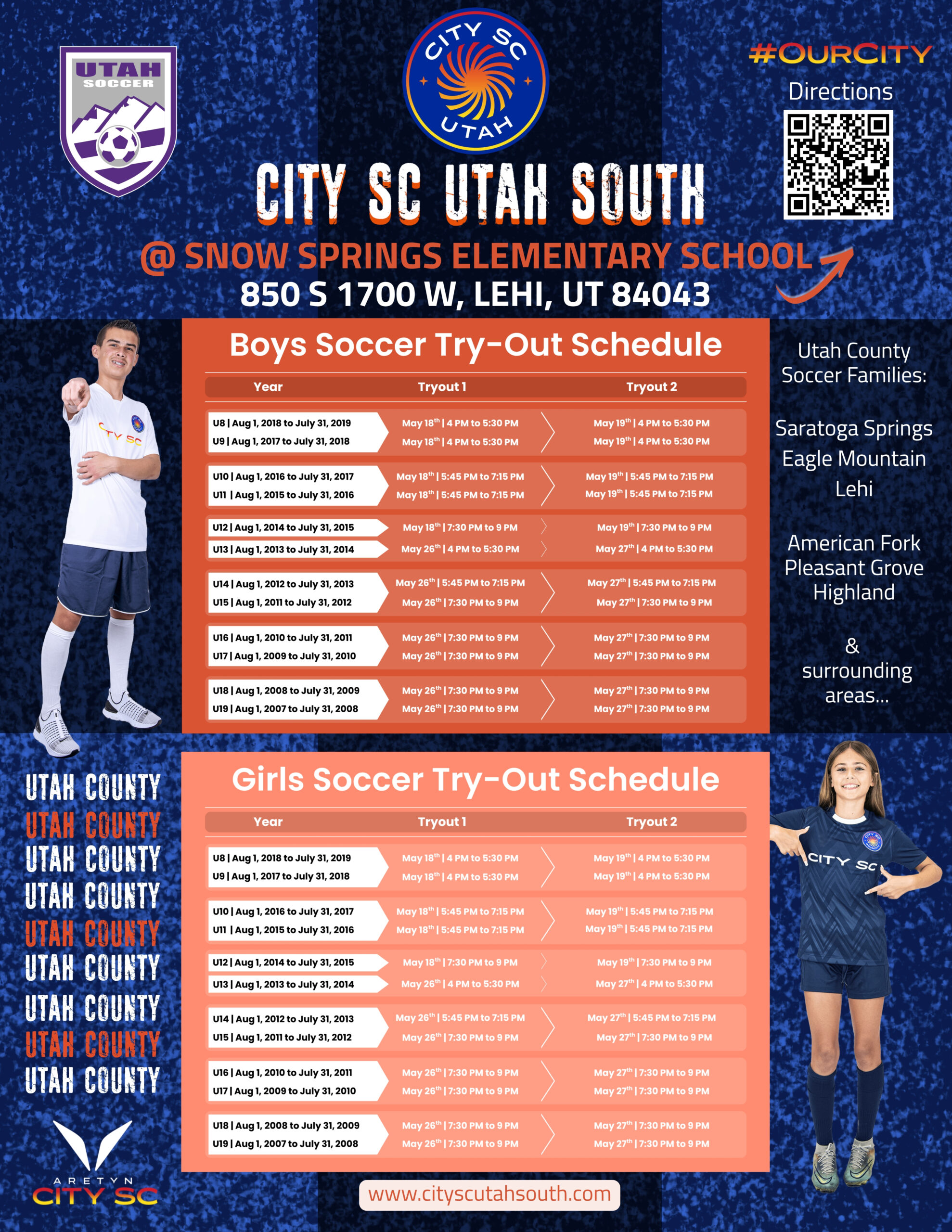
SOUTH TRYOUTS
- Location: Snow Springs Elementary School (850 S 1700 W, Lehi, UT 84043)
- TRYOUT REGISTRATION MUST BE COMPLETED ONLINE, PRIOR TO CHECK-IN
- Tryout cost is $20 per player (no refunds)
- Arrive 30-40 minutes early the first day of tryouts, for check-in.
- Tryout t-shirts will be provided and MUST be worn each day of tryouts
- ONLY players and City staff are allowed on the fields during tryouts.
- Each player must wear proper soccer attire (shorts, shin guards, cleats, etc.)
- Each player must bring a properly inflated ball (w/name on it) and plenty of water to drink
- Parking at the School, Lehi Sports Complex to the West & LDS Church building north of Snow Springs
- Parents, please stay nearby, in the event of bad weather.
For more information contact
Contact: Jeremy Alvernaz, Coquito De Vettori
Email: jalvernaz@cityscutah.com cdevettori@cityscutah.com
Fees
Coming Soon 2026/2027 fee’s
| Premier/Elite | U9 | U10 | U11 | U12 | U13 | U14-U19 |
| Coach/DOC/TD fee | ||||||
| UYSA/CitySC/Registrar/Manager | ||||||
| Equipment/Fields/Ref Assignor | ||||||
| Financial Assistance | ||||||
| Administrative | ||||||
| Monthly Rate | ||||||
| Yearly Total | ||||||
| Uniform Paid Separately |
Hiring Coaches